Every promoter has a guestlist horror story. The name that was definitely added but somehow wasn't there. The friend of a friend who swears they're on 'the list' with two plus ones. The door person who had to call you mid-set. The queue backed up because nobody could read the handwriting.
Guestlists aren't glamorous. But they're one of the highest-leverage tools a promoter has and most people are running them like it's 2009.
What a Guestlist Actually Is (and Isn't)
A guestlist is not a favour system. It's a capacity management tool. You're making deliberate decisions about who gets in at what price: comped/free, reduced, or full. Those decisions have direct revenue implications.
When you treat it like a favour system, you lose track of numbers, you create awkward moments at the door, and you end up comping more than you planned because there's no structure to push back against. When you treat it like a system, you know exactly how many spots you've allocated, who's confirmed, who's a no-show risk, and what your door revenue looks like before the night starts.
Not All Guestlists Are the Same
This is where most operators go wrong. They run one single list and lump everyone on it: artists, staff, promoters, journalists, the venue owner's mate. That list becomes unmanageable fast, and when things go sideways at the door, nobody can tell whose comp is whose.
The fix is to think in categories. Here's how a well-organised guestlist operation typically breaks down:
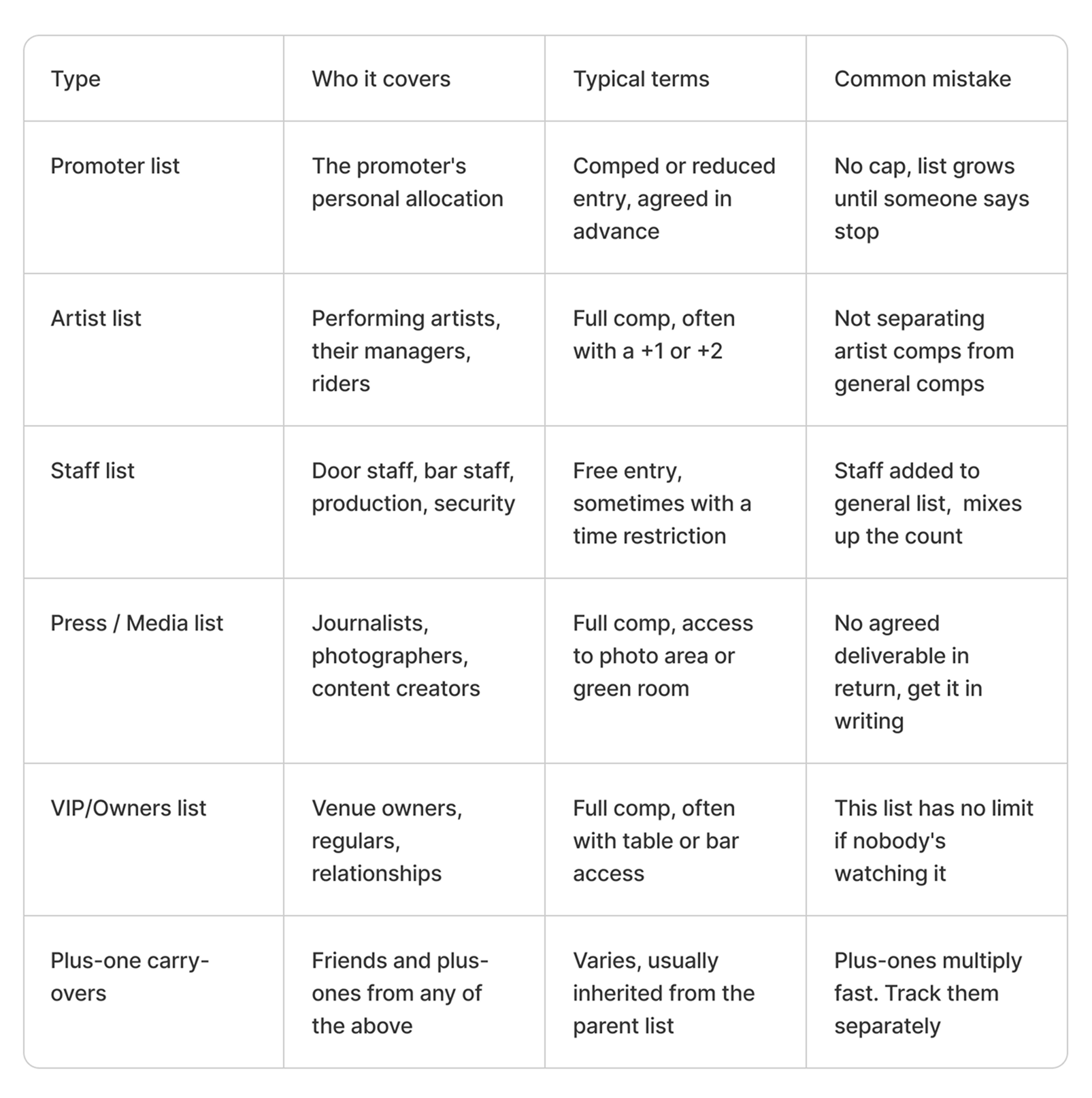
The reason this matters: each list type has different rules, different limits, and should be managed by different people. Your artist list shouldn't be editable by your bar staff. Your promoter allocations should be capped before the night, not negotiated at the door.
Keeping them separate also gives you clean data after the event. How many artist comps showed up, how many didn't, where the no-shows concentrated? That's the kind of intel that helps you tighten the operation over time.
How Most People Actually Manage Guestlists (And Why It Breaks Down)
The WhatsApp method: someone DMs you, you add them to a note on your phone. Works for 20 people. Falls apart at 80.
The spreadsheet method: better than a phone note, still a mess when three people are editing it at night and one version is out of sync.
The paper clipboard: fine if your door person has good handwriting, catastrophic if they don't.
The problem isn't any single tool. It's that none of them are built for the actual job, adding names remotely, setting limits per promoter, tracking arrivals in real time, and handling changes at 10pm on a Friday.
The Tools That Actually Exist (and What They Cost)
There are real tools built for this. Here's an honest comparison of what's on the market in 2025:
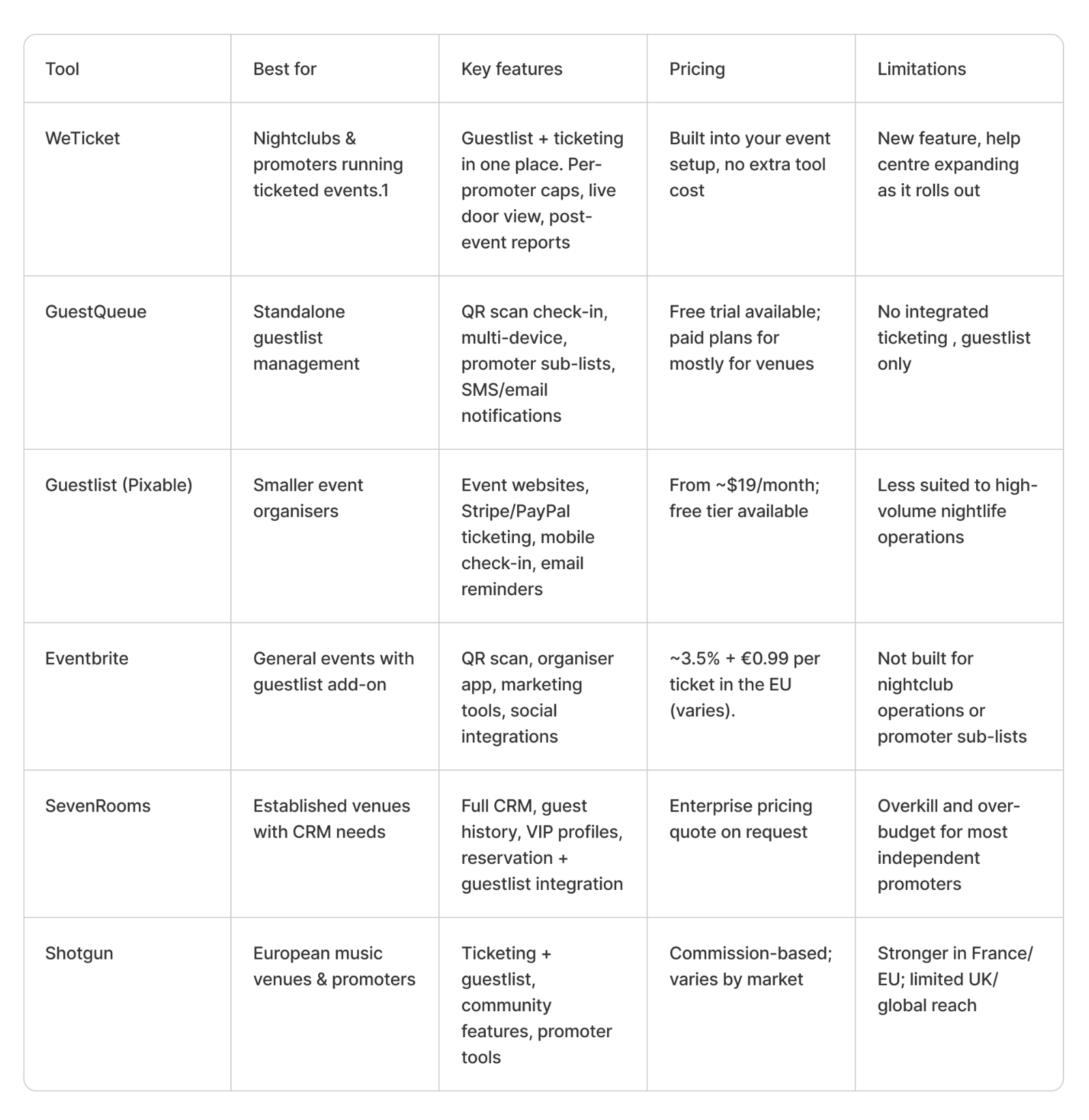
A few things worth noting: most standalone guestlist tools are guestlist only — which sounds obvious, but it means you're managing your tickets in one place and your door list in another. That split is where errors happen. If you're already ticketing through a platform, look for one that handles guestlist natively so everything lives in the same system.
Negotiating Guestlist as a Promoter
If you're a promoter working with a venue rather than running your own room, the guestlist conversation is part of the deal and you should treat it that way.
Standard practice: agree on a total allocation upfront. A set number of comps and a set number of reduced-price entries. Get it in writing. Don't assume the venue and you have the same understanding of what 'guestlist' means.
A few things worth pushing for: control over your own allocation so you can manage names without going through the venue; clarity on what 'comp' actually means (free entry only, or entry plus a drink?); and no-show transparency, if you get 30 spots and 18 show up, that's leverage for next time. But only if you're tracking it.
When Is It Worth Paying for a Guestlist Tool?
Honestly? Earlier than most people think.
If you're running more than one event a month, the coordination cost of manual guestlists, your time, the mistakes, the door friction, almost certainly exceeds what a tool costs. The real question isn't whether to use one, it's whether you're using one that was actually built for nightlife operations.
The decision point is usually the moment you have more than one person managing names. That's when things go wrong in ways that are hard to unpick after the fact.
Name Search vs. QR Code: Which Check-In Method Should You Use?
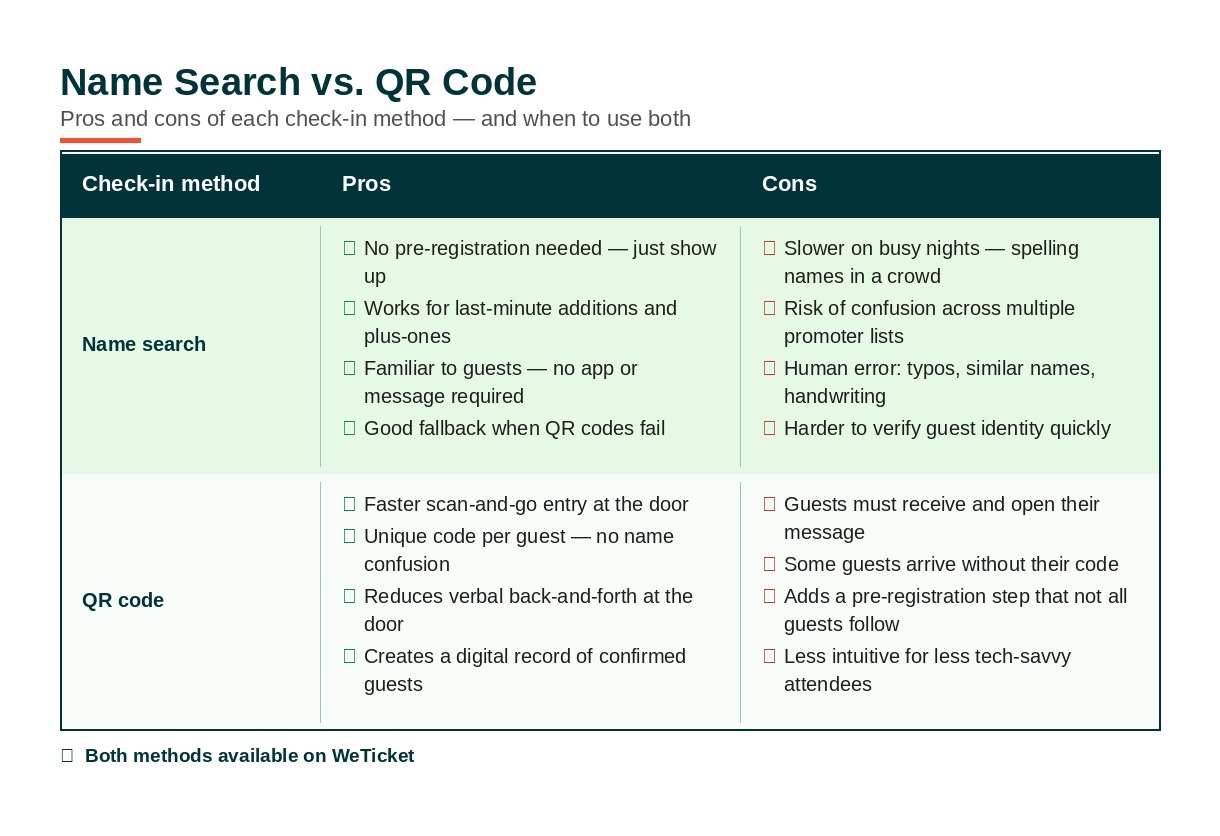
Once your list is built, there's still one decision left: how does the door actually check people in? There are two ways to do it, and both have a real place depending on the night.
Name-based check-in
is exactly what it sounds like. The door person searches the name, finds it, marks it off. No QR code, no pre-registration step required from the guest. Low friction on the guest side, they message someone, get added, show up, give their name.
The downside is speed. On a busy night, searching a name through a crowd while someone spells it at you is slower than scanning a code. It also relies on the guest knowing whose list they're on, which, if you're running multiple promoter allocations, becomes its own chaos.
QR code check-in
sends the guest a unique code when they're confirmed. They show it at the door, it gets scanned, they're in. Faster, more secure, and it removes the 'my name should be on there somewhere' conversation entirely.
The tradeoff: it adds one more step for the guest upfront. Not everyone reads the message. Some people show up without the code, and then you're back to searching manually anyway. For certain crowds, less tech-forward events, older audiences, this causes more friction than it solves.
The right answer is having both. QR codes as the primary flow for anyone pre-confirmed. Name search as the fallback for late additions, plus-ones, and anyone who didn't check their messages. Running one without the other is where door queues come from.
How WeTicket Handles This
WeTicket's guestlist tool supports both check-in methods. Guests can be sent a QR code on confirmation, and the door team has live name search running in parallel — so if someone shows up without their code, you're not stuck. Promoters manage their own allocations within caps you set, the door gets one live view, and at the end of the night you get a clean arrival report by list type.
Because it sits inside WeTicket's ticketing platform, your comps and paid tickets are in the same system — one door view, one data set, no version confusion. For the full setup guide, visit the WeTicket Help Centre — including how to configure QR code delivery, set per-promoter caps, and pull your post-event guestlist report.
Your guestlist is one of the few things in events that's entirely within your control before the night starts. Set it up properly and it runs itself. Don't, and you'll be on your phone at midnight sorting out names while the music's playing.
That's not the job.

.png)
